Bloat (GDV) in Dogs: Symptoms, Prevention and Emergency Signs
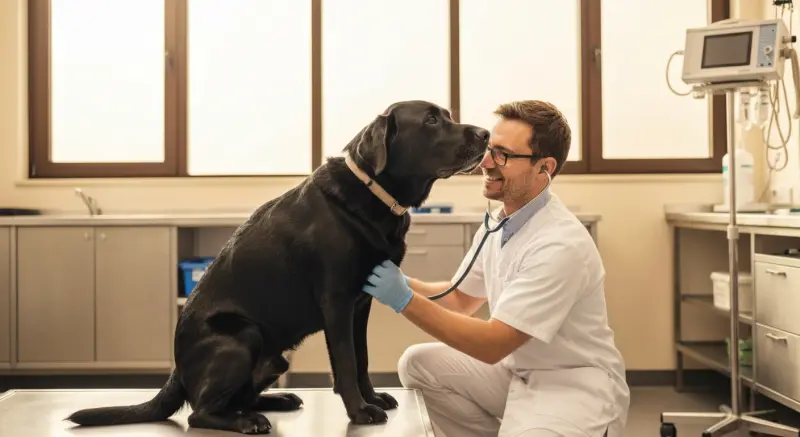
Gastric dilatation-volvulus (GDV), commonly known as bloat, is one of the most serious veterinary emergencies in dogs. The stomach fills with gas and food, then twists on itself, cutting off the blood supply. Without surgical intervention within 1 to 2 hours, the mortality rate reaches 30%. Understanding the causes and prevention measures can quite literally save your dog's life.
What is bloat (GDV)?
Bloat, or gastric dilatation-volvulus (GDV), happens in two stages. First, the stomach distends excessively under the effect of gas, food and fluids — this is the dilatation. Then, in the most severe cases, the stomach rotates on its axis — this is the volvulus. This rotation compresses the blood vessels, blocking venous return to the heart and cutting off the blood supply to the stomach and the spleen.
According to the Journal of Veterinary Internal Medicine (2020), GDV affects around 6% of large-breed dogs at some point in their lives, with peak incidence between 7 and 12 years of age. The Great Dane is the most affected breed, with a lifetime risk estimated at 37%.
The warning symptoms
Bloat develops within a few hours. Recognising the early symptoms allows for rapid treatment:
- A swollen, hard abdomen — the distended stomach is palpable and painful to the touch
- Unproductive attempts to vomit — the dog strains but nothing comes up (the twist blocks the exit of the stomach)
- Restlessness and discomfort — the dog can't find a comfortable position, constantly getting up and lying down
- Excessive drooling — the dog salivates heavily
- Rapid, shallow breathing — the distended stomach presses on the diaphragm
- Pale or bluish gums — a sign of advanced circulatory shock
- Collapse — in advanced cases, the dog collapses and can no longer get up
If your dog has a swollen, hard abdomen together with unproductive attempts to vomit, it's an absolute emergency. Every minute counts. Don't waste time phoning around — go straight to the nearest emergency vet.
— Dr. Sarah Whitmore, veterinary nutritionistThe predisposed breeds
GDV mainly affects large, deep-chested dogs. According to the American Kennel Club Canine Health Foundation, the breeds most at risk are:
- Great Dane (37% lifetime risk)
- Irish Setter
- Saint Bernard
- German Shepherd
- Labrador Retriever
- Golden Retriever
- Weimaraner
- Bernese Mountain Dog
That said, no dog is entirely safe. Cases have been reported in medium-sized breeds (Basset Hound, Boxer) and even in small breeds in rare instances.
The proven risk factors
Veterinary research has identified several factors that increase the risk of GDV:
- Eating too fast — the number one risk factor according to Purdue University (2000). Dogs that eat quickly swallow large amounts of air (aerophagia)
- One large meal a day — a very full stomach is more likely to distend and twist
- Intense exercise after a meal — running or playing within 2 hours of eating increases the risk
- Stress and anxiety — anxious or stressed dogs are more likely to develop GDV
- Family history — the risk is 63% higher in dogs whose parent has had GDV
How to prevent bloat
1. Slow down eating with a slow feeder dog bowl
This is the simplest and most effective preventive measure. The Slow Feeder Dog Bowl multiplies mealtime by 10, dramatically reducing aerophagia. Its anti-gulp ridges force the dog to eat one piece of kibble at a time, whatever its size, and its BPA-free material makes it safe for everyday use.
2. Split meals into smaller portions
Give 2 to 3 small meals a day rather than a single large meal. A moderately full stomach is far less likely to distend.
3. Avoid exercise after a meal
Wait at least 1 hour (ideally 2 hours) after a meal before any physical activity. Post-meal rest lets the stomach begin digestion safely.
4. Reduce stress at mealtimes
Feed your dog in a calm spot, away from other animals and household commotion. Stress increases aerophagia and eating speed.
5. Preventive gastropexy
For very high-risk breeds (Great Dane, Irish Setter), some vets recommend a preventive gastropexy — a surgical procedure that anchors the stomach to the abdominal wall to stop it from twisting. It is often carried out at the same time as neutering.
⚠️ This article is for information only and does not replace a veterinary consultation. If your dog shows symptoms of bloat, contact an emergency vet immediately.
Prevent bloat (GDV)
The Slow Feeder Dog Bowl is the simplest way to protect your dog.
See the slow feeder dog bowl →